
In this letter, the school leadership at Ma’ayanot Yeshiva High School for Girls addresses the distressing events in Israel and the alarming increase in Antisemitism in the United States. Expressing disappointment in some universities’ efforts to ensure the safety of Jewish students, they prioritize the physical and emotional health of their students. Changing their approach to hosting college representatives, they now require detailed safety plans from universities recruiting at their school. The letter underscores the commitment to educating students about campus climates, with the hope that collective efforts will inform wise choices for their future. The leadership thanks families for their partnership and assures them of their readiness to address any questions.
Winter 2024 Journal Credits
JEWISHEDUCATIONALEADERSHIP Jewish Educational Leadership is a publication of The Lookstein Center for Jewish Education of Bar Ilan University. Journal Staff Hyim Brandes | EditorChana German | Executive DirectorZvi Grumet | Editor-in-ChiefLeah Herzog | Editorial...

Pulling Back from the Trees and Looking at the Forest: Making Torah Meaningful to Students’ Lived Lives
Why might a student who has attended our community’s schools for so many years, schools into which the community pours so many resources, decide that, at least temporarily, they are not interested in being part of our community? I won’t pretend that I know the answer, but I do believe…
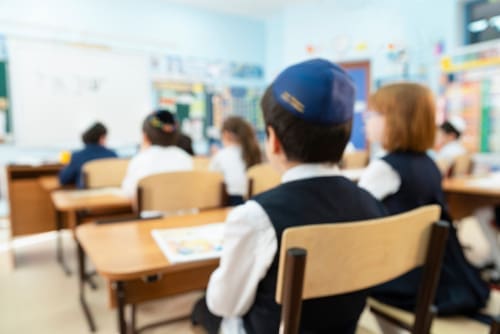
Why Do We Teach—and Not Teach—What We Do in Jewish Schools?
Recently, a teacher asked me for some guidance. What did I think would be both the best content and methodology not only for teaching skills but also for conveying fundamental values and fostering a love for and connection to Judaism?

FROM THE EDITOR: Fall 2023
Fascinating. Infuriating. Uplifting. Complex. Boring. Inconsistent. Logical. Brilliant. Eclectic. Irrelevant. Compelling. Frustrating. Inspiring. Ancient. Contemporary. The Talmud evokes all the above, and more. I vividly remember my first encounter with Gemara. I must have been ten years old, and my family was in a bungalow colony in the Catskills. Rabbi Cohen taught Gemara to the older boys, of which I was not, but I asked permission to sit in and listen. I loved following the discussions and debates, even though I couldn’t read any of it and retained none of the content.

The Block Method for Teaching Gemara
By its very nature, teaching Gemara seems to defy everything we know about education. When we teach math, or language, or anything else, we start with the simple and easy-to-grasp aspects of the study area and gradually increase the level of challenge and difficulty. For example, we begin with addition and slowly move on to subtraction, multiplication, and division. We certainly don’t touch algebra until these are firmly in place. One couldn’t imagine a math class that requires knowledge of Pythagoras’ theorem presented to a class that has not yet mastered multiplication.

The Puzzling Talmud
A sixteen-year-old American Jewish day school student named Brandon (a self-chosen pseudonym) reports that he likes studying Talmud. What does he like about it? “I like the process,” he says. “It is kinda like a puzzle, that you have to get each word, and fill it in so it creates the whole text.” Brandon approaches his study of Talmud knowing that it’s going to be hard. Every word might take some effort to decode. Eventually, however, he can put it all together.

A Multidimensional Approach to Teaching Rabbinics
Pressman Academy is an early childhood through 8th grade school in Los Angeles serving a religiously diverse group of students. The school’s Judaics program, which includes Hebrew language, Jewish history, Tanakh, and daily prayer, affords a maximum of two weekly periods to teaching Rabbinics (in grades 5-8), presenting a significant challenge of what to include and how to approach it.

The Sanhedrin is in Session: Experiencing Rabbinic Literature
On Tuesday morning Rabban Gamliel called the gathered people to order. A letter had arrived from a northern district court in the Galilee which required the attention of the Sanhedrin. Rabban Gamliel took his seat at the head of the semi-circle of esteemed Rabbinic colleagues. R. Yehoshua sat on one side of him and R. Eliezer sat on the other.

Replacing Relevance with Relationship
A relationship to Talmud study is highly valuable to those who possess it. Few other activities manage to combine elements of intellectual inquiry, spiritual questing, and moral development in the almost alchemical way that the study of Talmud does. And yet, there are a number of hurdles students must overcome in order to develop an independent relationship with the Talmud. First and foremost, studying Talmud in the original Hebrew and Aramaic can feel scary to the uninitiated. Second, the logic of the Talmud is foreign to students at first. Finally, students may wonder what a text from 1500 years ago might have to say to them.